Search
 The Employer Handbook Blog
Employers, Take Note: A New FTC Noncompete Inquiry Could Shape Compliance


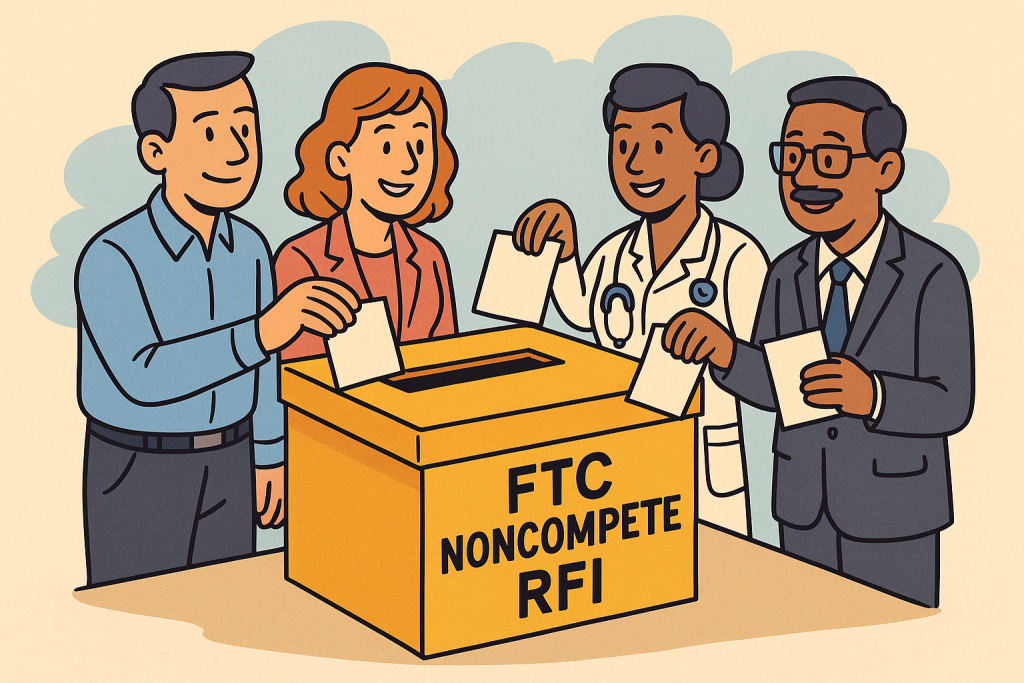
The Federal Trade Commission isn’t finished with noncompetes. It is gathering information to understand when these agreements cause real harm and when they may serve legitimate business purposes. Case in point: its latest enforcement action against an employer that allegedly relied on broad, boilerplate restrictions.
TL;DR: The FTC has launched a public inquiry seeking information on how noncompete agreements are used in the workplace, with a submission deadline of November 3, 2025. At the same time, the Commission finalized a consent order with a large employer after alleging its noncompetes bound nearly 1,800 workers. The order illustrates a case-by-case, non–one-size-fits-all approach.
The FTC Wants Intel
On September 4, the FTC issued a Request for Information to understand the scope, prevalence, and effects of employer noncompete agreements. The agency made clear that it seeks evidence to guide case-by-case enforcement, not a blanket ban.
The RFI seeks details including: which employers use noncompetes, the roles and salary ranges affected, the employers’ stated justifications, the terms and geographic scope, and how aggressively the restrictions are enforced. It also invites examples of employee harms, entrepreneurship effects, competition barriers, innovation impacts, and healthcare-specific issues.
The Commission encourages input from current and former employees, employers facing hiring difficulties due to rivals’ noncompetes, and market participants in the healthcare sector, among others. The goal is to uncover real-world details that traditional investigations may overlook.
The FTC accepts both confidential submissions by email and public comments through Regulations.gov, and it cautions filers not to include sensitive personal data. Submissions are due November 3, 2025 at 11:59 p.m. ET.
Case in Point
The FTC also announced that it had recently filed a complaint and finalized a consent order requiring a large employer to cease enforcing noncompete agreements against its employees.
In the complaint, the FTC alleged the employer required one-year, nationwide noncompetes for nearly all workers and, in at least one instance, had employees sign agreements shortly before a facility closed.
Under the consent order, the employer must immediately stop enforcement of existing noncompetes (with narrow exceptions for certain senior employees tied to equity grants and in connection with a bona fide sale of a business), refrain from telling anyone that covered workers remain bound, send individualized notices, and post a clear new-hire notice that employment is not subject to a noncompete. The order also limits any customer non-solicit to customers the employee directly served in the prior 12 months.
It has a 10-year term and requires the company to provide initial and periodic compliance reports.
What Employers Should Do Now
Audit your agreements. Take stock of existing noncompetes and nonsolicits across your workforce. Identify who is covered, the duration, and any applicable geographic scope. Broad, boilerplate language is far more likely to invite regulatory scrutiny.
Tailor carefully. If noncompetes are truly necessary, strongly consider limiting them to roles with access to sensitive information or strategic relationships. Document your legitimate business reasons so you can explain them if asked.
Consider alternatives. In many cases, confidentiality, trade secret protections, or narrowly drawn non-solicitation clauses can protect the business without the same legal risk. These options may better align with the FTC’s guidance.
The Bottom Line
The FTC is not adopting a one-size-fits-all rule. It is moving toward a surgical, case-by-case approach guided by public input and targeted enforcement. Employers that continue to rely on sweeping restrictions should be ready to justify them or rethink their strategy.