Search
 The Employer Handbook Blog
A Eulogy: “Noncompete Rule, We Hardly Knew Ye”


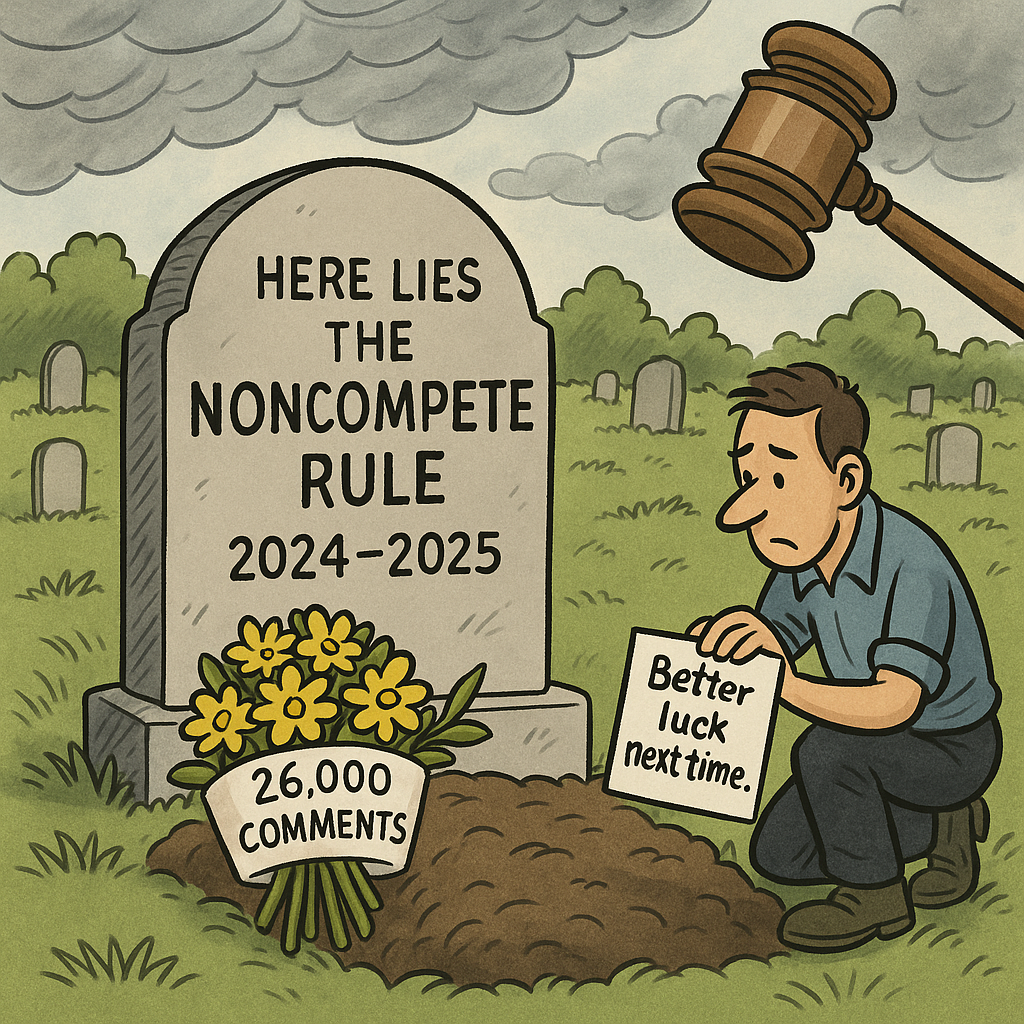
It promised freedom, delivered litigation, and left us with… state law.
Friends, colleagues, HR professionals, lend me your ears.
We gather today to mourn the passing of the Noncompete Rule, a sweeping reform that promised to free 30 million American workers from contractual shackles but instead met its end in a federal courtroom, abandoned by the very agency that gave it life.
The Noncompete Rule was born in April 2024, to great fanfare. It was heralded as a bold reform for American workers, projected to generate 8,500 new businesses each year, raise wages, lower health care costs, and even boost patent filings. FTC Chair Lina Khan presided like a proud parent, proclaiming that the rule would “ensure Americans have the freedom to pursue a new job, start a new business, or bring a new idea to market.”
But alas, our dearly departed was short-lived. By August 2024, a district court halted enforcement, and a year later, the Trump-Vance FTC decided to pull the plug entirely, dismissing appeals and acceding to vacatur. The cause of death? A lethal combination of judicial skepticism, statutory doubts, and political shifts.
Commissioners paid their respects in very different tones:
-
Chairman Ferguson and Commissioner Holyoak offered a brisk “we told you so,” noting the rule was unlawful “six ways from Sunday.”
-
Commissioner Meador praised balance but agreed the categorical ban had gone too far.
-
Commissioner Slaughter, in dissent, decried the decision as a betrayal of millions of workers trapped by “draconian” restrictions.
And so, the Noncompete Rule leaves behind a legacy of unfulfilled promises, 26,000 public comments, and a stack of litigation that will keep law students busy for decades.
In the end, the Noncompete Rule was like the Taylor Swift–Travis Kelce romance: it captured headlines and fanfare. But unlike the couple still going strong, the Rule dragged on for more than a year before flaming out, in the same reliable fashion as the Dallas Cowboys’ Super Bowl dream.
May it rest in peace in the Federal Register archives.
Litigation Status
On September 5, 2025, the FTC formally announced its intent to end its appeals in Ryan, LLC v. FTC (5th Cir.) and Properties of the Villages v. FTC (11th Cir.) and agreed to accede to vacatur. Read the FTC’s September 5, 2025 press release.
That move effectively ends all pending litigation over the rule. Courts had already concluded that the FTC lacked authority to issue such a sweeping ban, and with the agency surrendering, there will be no Supreme Court review and no inconsistent appellate rulings to keep the cases alive.
In short, the noncompete rule is legally dead. What remains are state laws, antitrust enforcement, and targeted cases challenging specific noncompetes.
Employer Takeaways (the serious part)
-
Noncompetes live on (for now). With the FTC rule vacated, regulation of noncompetes returns to the states. Employers must comply with the patchwork of state laws, some banning noncompetes entirely, others restricting them to higher-paid workers, and many still enforcing them under “reasonableness” tests.
-
Expect continued scrutiny. Even without the rule, the FTC, DOJ, and private plaintiffs can and do challenge noncompetes under federal laws such as the Sherman Act and FTC Act when used anticompetitively. State attorneys general are also increasingly active.
-
Use alternatives. The FTC and courts have repeatedly pointed to less-restrictive tools: non-disclosure agreements, reasonable non-solicitation clauses, trade secret protections, and better compensation to retain talent. Overreliance on noncompetes remains risky.
Conclusion
The Noncompete Rule may be dead, but the debate over noncompetes is very much alive. Employers should treat this moment not as a victory lap, but as a reminder: broad restrictions can still draw lawsuits, bad press, and political attention. The safest strategy is to use noncompetes sparingly, narrowly, and only where genuinely necessary.
Because while the rule has been laid to rest, the ghosts of overbroad noncompetes may come back to haunt you.