Recently in National Origin Category

April 26, 2012

5 takeaways from the EEOC's new guidance on use of criminal records

Thumbnail image for jail.jpg

Yesterday, the US Equal Employment Opportunity Commission issued updated Enforcement Guidance on employer use of arrest and conviction records in employment decisions under Title VII of the Civil Rights Act of 1964. (Title VII is the federal statute that prohibits discrimination in the workplace based on race, color, religion, sex and national origin). You can read a full press release on the updated Enforcement Guidance here.

The press release includes a link to questions and answers about the EEOC's Enforcement Guidance. However, I will summarize the most important points for employers after the jump...

* * *

Continue reading "5 takeaways from the EEOC's new guidance on use of criminal records" »

April 5, 2012

Is a workplace "English-only" rule legal?

Geno's Steaks - Philadelphia, Pennsylvania 6

Unfair treatment because of one's language may be related to race or national origin discrimination. Indeed, language may be used as a covert basis for discrimination.

But that's not always so. A recent case and some helpful nuggets on English-only rules after the jump...

Continue reading "Is a workplace "English-only" rule legal? " »

April 4, 2012

Employment discrimination by the numbers: Foreign Edition

hollowglobe.jpgNow in autotune.

(Betcha didn't expect that).

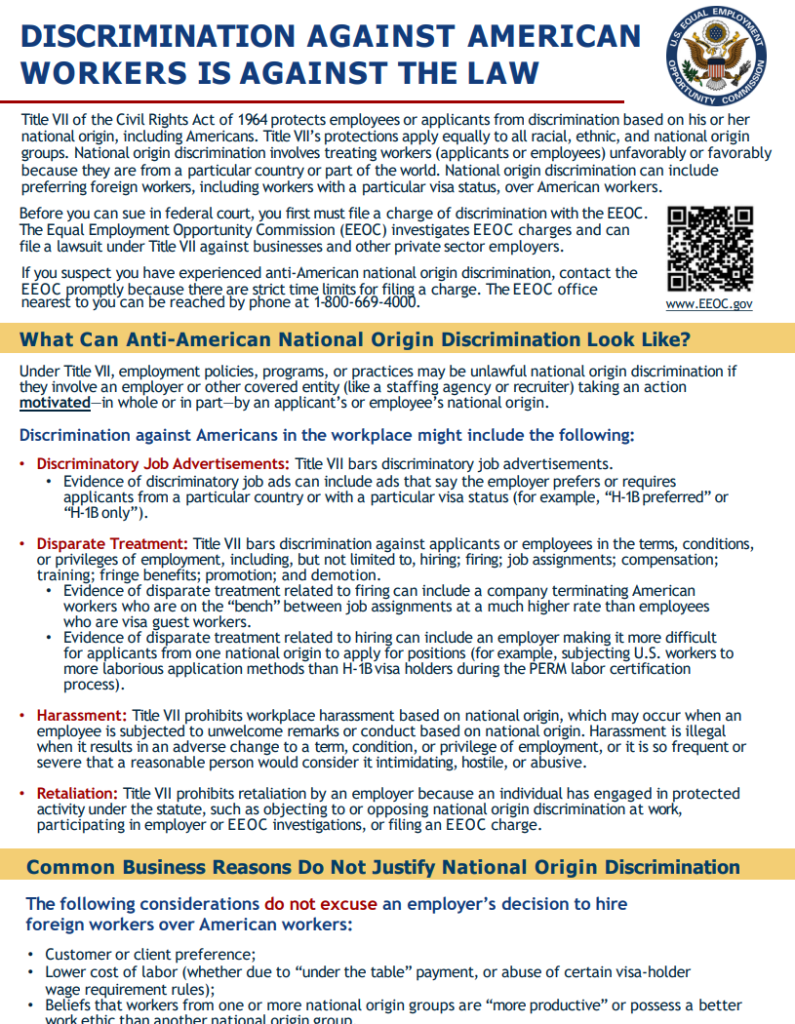
Yesterday, we were rapping (without the benefit of autotune) about immigration status and unlawful discrimination and concluded that Title VII of the Civil Rights Act of 1964 does not prohibit workplace discrimination on the basis of immigration status (although national-original discrimination is unlawful). And we know from a super-hot "Fact or Fiction" post last year that Title VII covers Americans who are employed abroad. It was so hot.

Now, get ready for the hat trick, Gretzky.

Late last month, a federal court in Michigan recognized that foreign employees of a foreign employer should not be counted as employees for purposes of Title VII. Who cares, right? Well, you should. As you know from this post, you need 15 employees to be covered under Title VII. If ABC Company has 14 employees working at a US facility and 1 more employee, a Canadian resident, who works exclusively for ABC in Canada, ABC is not covered under Title VII.

This could also become an issue, as it did in the Michigan case, where an employer is right up against a statutory damages cap. Caps are placed on compensatory damages according to the size of the employer. The limits on damages are as follows:

15 to 100 employees: $50,000
101 to 200 employees: $100,000
201 to 500 employees: $200,000
501 employees or more: $300,000

Notwithstanding the foregoing -- or something legalese like that -- state laws covering workplace discrimination and damages caps may vary. So, mind your p's and q's. Or maybe you just shouldn't discriminate at all.

April 3, 2012

Are aliens protected from illegal workplace discrimination?

Led Zeppelin 2203730020I had this song in my head for about two hours on Sunday.

Then I listened to the Trent Reznor version, ick....

This blog post has a point, right? Oh yeah, discrimination. A little reminder from a recent Eight Circuit case, Guimaraes v. SuperValue, Inc., that when it comes to employees with green cards, discrimination under Title VII on the basis of national origin is illegal. However, Title VII discrimination based on citizenship or immigration status is not:

Guimaraes conflates citizenship or immigration status with national origin. Her green card process shows her intent to change her citizenship or immigration status by becoming a lawful permanent resident. True, a reasonable jury could find the "green card" statement evinces an intent to terminate Guimaraes because she is not yet a lawful permanent resident. The Supreme Court has held, however, that while aliens are protected from illegal discrimination under Title VII, nothing in Title VII makes it illegal to discriminate on the basis of citizenship or alienage.

Of course, employers that do discriminate on the basis of immigration status do so at their own risk -- like the risk of getting sued for national-origin discrimination.

Update: As adroitly noted in the comments below, the scope of this post is limited to Title VII. 

May 13, 2011

Give me a D-I-S-C-R-I-M-I....(you get the point)

malori1.jpgI had trouble sleeping last night.

If you read yesterday's post, you know that when deciding between a post about an NFL cheerleader who was fired for risque pictures mailed to the Indianapolis Colts versus labor law and Twitter, I chose labor law and Twitter.

***stupid Twitter!***

I won't make the same mistake twice. So, without further ado, I have the pictures federal-court complaint of the fired cheerleader and a brief rundown of her chances of success.

***Oh, Twitter. I can't stay mad at you. I'll give you a foot rub -- right after I finish this can of Four Loko.***

Don't judge me. Just skip past the jump. TGIF, yo.

* * *

Continue reading "Give me a D-I-S-C-R-I-M-I....(you get the point)" »