Recently in Discrimination and Unlawful Harassment Category

May 17, 2012

EEOC now publishes charge data, by state. Have a look...

Thumbnail image for EEOC.jpg

You can access the state-by-state charge data here here. And view it all in a single downloadable spreadsheet here.

In the Commonwealth of Pennsylvania, individuals filed 4,302 charges of discrimination in FY2011, which amounts to 4.3% of the total number of US charges filed. As with Americans across the country, retaliation was the most popular box checked (37.2% of all charges) in Pennsylvania. However, disability was number two in PA (31.1%) versus a national average of 25.8%, which pales compared to race and sex, nationally. Rounding out the top five in PA were: (3) sex (30%); (4) race (27.3%); and (5) age (27.3%).

Across the river in New Jersey, which has two-thirds the population of PA, residents filed less than half the number of charges (1,841) with the EEOC in FY2011 as were filed in PA. The reason? I suspect it is because individuals who have claims under the New Jersey Law Against Discrimination, which is very similar to the federal discrimination laws, do not need to file a claim with the New Jersey Division on Civil Rights, the state's administrative agency, before going to court. The top five boxes checked on NJ EEOC charges were: (1) retaliation (35.1%), (2) race (33.9%); (3) disability (25.8%); (4) sex (24.8%); and (5) age (23.3%).

And now, for the state of love and trust, play us out, Pearl Jam.

February 7, 2012

What box got checked most at the EEOC in 2011?

eeoclogo.pngFor the second year in a row, it was retaliation. Of the nearly 100,000 Charges of Discrimination that employees filed with the EEOC in 2011, retaliation claims accounted for just over 37% of them. Race claims were just behind at 35.4%. Sex was third at 28.5%.

A complete breakdown of 2011 EEOC charge statistics can be found here.

December 30, 2011

Your favorite "The Employer Handbook" posts from 2011

handfive.jpg

As the year draws to a close, let's take a look back at the most popular posts at The Employer Handbook in 2011, based on number of hits:

5. Social media and the workplace. School teacher Natalie Munroe made several appearances on the blog this year. Remember her? She was the blogging school teacher who wrote that her students were "utterly loathsome in all imaginable ways." Although, Ms. Munroe eventually returned to work, her experience is a sound reminder to always think twice before hitting "send." You can read the fifth-most-popular post, "Yes, you CAN discipline employees who abuse social media" here.

4. I'm a poet and I don't even know it. I'm not sure what inspired the fourth-most-popular post. It must have been a slow news day. How else do I come up with the idea to Haiku -- verbing a noun, sorry -- about recent employment-law decisions from the U.S. Supreme Court?

3. FMLA remains a hot issue. This one surprised me. The third-most-popular post is about FMLA legislation in Pennsylvania that never passed.

2. Short and sweet. The second-most-popular post was one of my shortest. I merely announced that the EEOC had finalized its ADAAA regulations. (Note to self: keep it short)

1. Yeah, I know, you only clicked "by accident." This was a runaway. Not even close. To put things in perspective, nearly 4% of all page views at The Employer Handbook were on this one story. Not to come off as too vain -- I'm sure I've done that already in my other stellar posts -- but nearly four times as many viewers checked out the number-one post than my blog biography. What else can I say? In the end, sex sells. (Note to self: keep it sexy).

Thank you to everyone who made The Employer Handbook such a success in its first year. We'll be back on January 3, 2012, the official one-year anniversary of the blog, with something short and sexy employment-law related. But possibly short and sexy.

Image credit: capl@washjeff.edu

November 18, 2011

U.S. employees had a lot of discrimination claims is FY2011

Thumbnail image for Thumbnail image for EEOC.jpgHow many claims were filed? And how much money did the U.S. Equal Employment Opportunity Commission recover for individuals? Find out after the jump...

* * *

Continue reading "U.S. employees had a lot of discrimination claims is FY2011" »

November 3, 2011

Fact or Fiction: A hostile work environment requires bad motives

That's right folks. It's time for another edition of "Fact or Fiction" a/k/a "Quick Answers to Quick Questions" a/k/a QATQQ f/k/a "I don't feel like writing a long blog post". So, let's get right to today's question:

Thumbnail image for ffiction.pngIf a former employee sues for discrimination, claiming to have been subjected to a hostile work environment, must the employee prove that the harasser acted with bad intentions? Put another way, if the harasser was just joking around, does the plaintiff lose the case?

No way! FICTION!!!

An employer is liable for a hostile-work-environment discrimination if the employee can prove five elements:

  1. the employee was subjected to certain conduct because of the employee's particular protected class (e.g., race, religion, national origin, gender, sex),
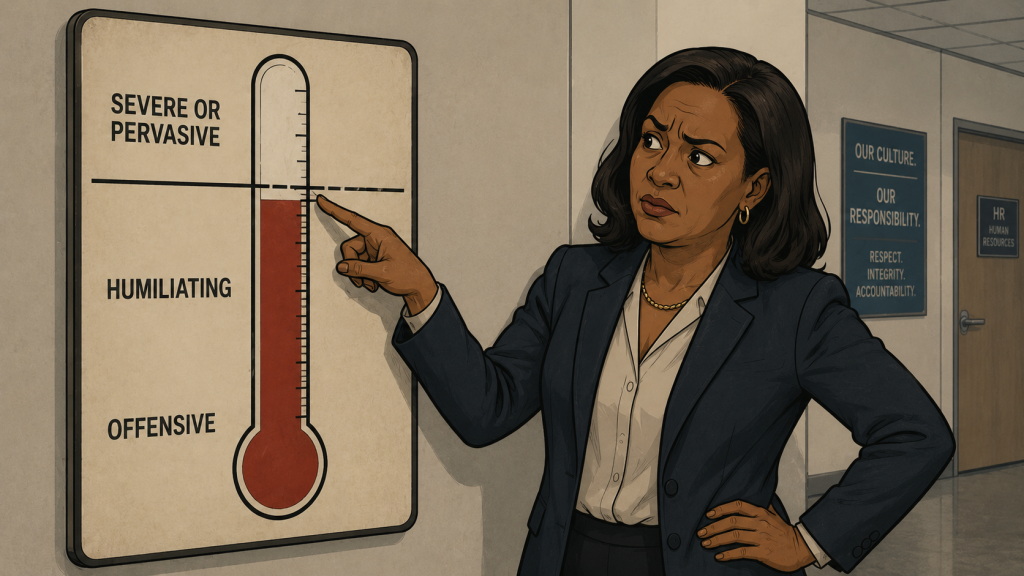
  2. the discrimination was severe or pervasive,
  3. the discrimination detrimentally affected the employee,
  4. the discrimination would detrimentally affect a reasonable person in like circumstances, and
  5. a basis for employer liability is present.

It does not matter whether the harasser intended to harm the victim. It only matters how the harasser's action's impacted the victim (and how someone in the victim's shoes would feel). This nuance, which many employees do not appreciate, is a crucial point to stress when conducting anti-harassment training -- before a lawsuit is ever filed.

October 27, 2011

Is your arbitration agreement worth the paper it's printed on?

deweytruman.jpgCourts have blessed written agreements between employer and employee to submit federal discrimination claims to arbitration. Here is an example. 

But, there's legal and then there's doing right. After the jump, how one employer got it wrong. Very wrong. Plus, what you can do to make sure that your business does not make the same mistake...

* * *

Continue reading "Is your arbitration agreement worth the paper it's printed on?" »

September 20, 2011

Fact or Fiction: Some U.S. discrimination laws extend worldwide

Thumbnail image for ffiction.png

That's right folks. It's time for another edition of "Fact or Fiction" a/k/a "Quick Answers to Quick Questions" a/k/a QATQQ f/k/a "I don't feel like writing a long blog post".

The answer to today's question is fact.

In 1991, the Supreme Court decided, in the companion cases of EEOC v. Arabian American Oil Co. and Boureslan v. Arabian American Oil Co., that Title VII of the Civil Rights Act of 1964, the federal statute which makes it illegal for employers to discriminate on the basis of race, color, religion, sex, and national origin, did not apply extraterritorially to regulate the employment practices of United States employers that discriminate against United States citizens abroad.

However, as the The U.S. Equal Employment Opportunity Commission notes in this Enforcement Guidance memorandum, Congress subsequently amended both Title VII and the Americans with Disabilities Act in 1993 to permit American citizens employed outside of the United States by an American employer or a foreign corporation controlled by an American employer to pursue legal claims. Note, however, that the 1993 amendment provides a defense for violations of Title VII or the ADA if compliance with those statutes, "with respect to an employee in a workplace in a foreign country," would "cause" a covered entity to "violate the law of the foreign country in which such workplace is located."

h/t ContractorPerspective.com

September 13, 2011

This old mother****** may just have an age discrimination claim

chevy.jpg

You know what's not a good business practice for a car dealership? Referring to an older male employee as "old man," "pops," and "old mother******" and then steering car sales away from him to younger employees. Age discrimination is serious business, yo.

Details on this gem after the jump...

Continue reading "This old mother****** may just have an age discrimination claim" »

September 12, 2011

By The Numbers: Employment laws by total employees

numbers.jpg

With so many employment laws out there, it's not easy to keep track of what those laws say -- let alone under which of them your business may be covered. 

Well, who loves ya! After the jump, it's employment laws by the numbers -- number of employees that is -- that your business must employ to be covered under certain specific federal employment laws. (I'll even throw in a few extra state statutes for my PA/NJ/DE readers).

GREAT BIG DISCLAIMER: What you'll find after the jump are the numerosity requirements for various federal laws. There are a slew of other legal hoops through which your business may need to jump. Be smart. Discuss them with an attorney. 

* * *


Continue reading "By The Numbers: Employment laws by total employees" »

July 26, 2011

When hiring: Just because you can ask it, doesn't mean you should

I received a comment to yesterday's post about 29 questions you should never ask a candidate in a job interview.

question.jpg

Laurie Ruettimann, who blogs at The Cynical Girl, questioned the real-world ramifications of making one of my 29 no-no's:

"Hey, Eric. Great list. I once had an employment lawyer tell me that you can ask any question -- you just can't make an employment decision based on the answers. Can you blog about that distinction? Asking versus action? I would love to get your thoughts on that!"

Ask and ye shall receive. Or is it, ye shall receive, yo? (If you don't read Laurie's blog, that last sentence flew right over your head).

Either way, I'll share my thoughts after the jump...

* * *

Continue reading "When hiring: Just because you can ask it, doesn't mean you should" »

July 25, 2011

What would Kenny Powers do? Interview questions to avoid

kenny.jpg

HBO Go may just be the best app ever.

Over the past two weeks, I've gotten current on Entourage and Game of Thrones, and begun watching Eastbound and Down. Watching characters like Ari Gold, Kenny Powers and Tyrion Lannister got me thinking. If these guys were in HR, what kind of questions would they ask potential hires in a job interview?

***You know, this all sounded so much better in my head.***

Whatevs.

After the jump, I have 29 questions you should never ask a candidate in a job interview.

* * *

Continue reading "What would Kenny Powers do? Interview questions to avoid" »

July 7, 2011

This term's top 5 employment-law Supreme Court rulings...in haiku

bonsai_treephoto © 2007 Zest-pk | more info (via: Wylio)Last month, the Supreme Court handed down - if not the most important - certainly, the highest-profile decision of this term with Wal-Mart v. Dukes. However, in addition to this headline-grabber, this term saw four other significant employment-law decisions from the High Court about which employers must take note.

After the jump, I revisit each case...in haiku.

* * *

Continue reading "This term's top 5 employment-law Supreme Court rulings...in haiku" »

June 23, 2011

EEOC buzz: deliberate discrimination against job seekers

_1070717photo © 2011 Mark Ou | more info (via: Wylio)Yesterday, the EEOC held a meeting to discuss what it deems a "major national problem"; namely, deliberate discrimination against job seekers based on their race, sex, age, national origin or other prohibited basis.

After the jump, I'll summarize the meeting and offer some tips for employers to help them stay off of the EEOC's radar.

* * *

Continue reading "EEOC buzz: deliberate discrimination against job seekers" »

June 8, 2011

Supreme Court limits an employer's ability to recoup attorney's fees

Thumbnail image for Supreme Court.jpgIn an employment discrimination action asserted under federal law, an employee-plaintiff may recover a reasonable attorney's fee if the plaintiff prevails. So too may an employer-defendant recover fees if it prevails and the court determines that the plaintiff's suit is frivolous.

But what happens if an employee-plaintiff asserts multiple claims against an employer-defendant and only some of them are deemed frivolous? What, if anything, may the defendant recover in attorney's fees?

The answer after the jump...

* * *

Continue reading "Supreme Court limits an employer's ability to recoup attorney's fees" »

April 27, 2011

Yikes! NJ discrimination victims may tack on a whistleblower claim

Consider this scenario:

Employee believes he is being discriminated against. Employee complains to Human Resources. HR investigates, but is unable to substantiate the employee's claims. Employee nonetheless sues his employer, alleging discrimination. While the lawsuit is pending, the employer fires the employee for reasons it claims are unrelated to the pending action.

whistleb.gifAccording to a recent unpublished NJ decision, the employee could have both a discrimination claim and a whistleblower claim under New Jersey's Conscientious Employee Protection Act (CEPA).

Ain't that some sh!t!

More on this important decision and the impact it may have on employers, after the jump...

* * *

Continue reading "Yikes! NJ discrimination victims may tack on a whistleblower claim" »