Recently in Philadelphia Category

January 18, 2012

Crime & Punishment: Beware what you ask Philly job applicants

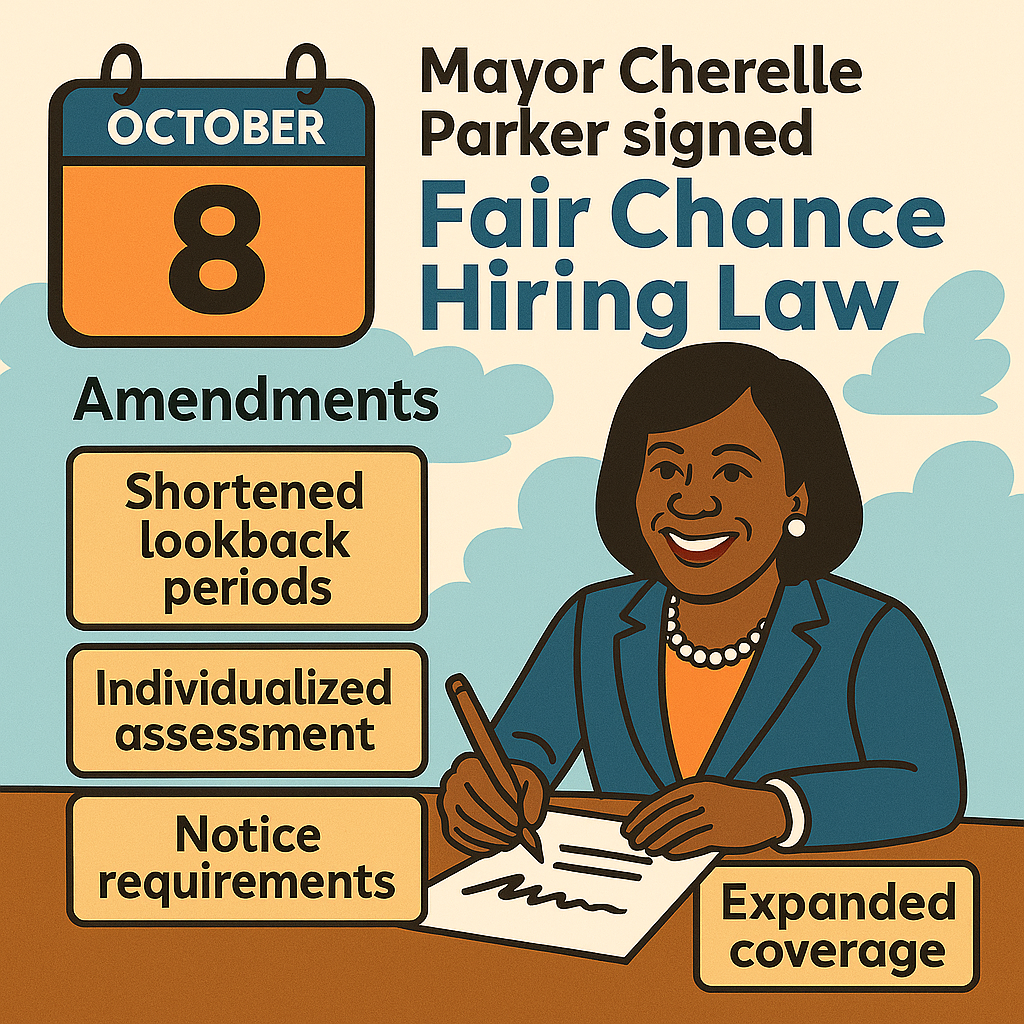
Thumbnail image for phillyskyline.JPGLast year, here and here, I discussed legislation that would prohibit Philadelphia employers from asking job applicants about certain arrests and making any personnel decisions based on records of an arrest that does not result in a conviction. That legislation is now the law. That law is the Philadelphia Fair Criminal Record Screening Standards Act.

Let's practice...

"So, do you have any old arrests for streaking across the field at Citizens Bank Park?" -- Illegal.

"How much would I have to pay you to skate across the ice at the Wells Fargo Center in a nude bodysuit?" -- Stupid. Inviting a sexual-harassment claim. But, technically, legal under the new Act.

For more specifics of the Act, check out this e-Alert from my Dilworth Paxson colleagues, Marjorie Obod and Katharine Hartman.

h/t Janette Levey Frisch

October 18, 2011

Paid-sick leave may become a requirement in Philly after all

phillyskyline.JPGOn June 29, The Employer Handbook reported here that Philadelphia Mayor Michael Nutter vetoed the "Promoting Healthy Families and Workplaces" bill. This bill would have required businesses to provide paid sick leave to employees who work a minimum number of hours in Philadelphia County.

Ah, but the times, they are a-becoming quite different. Right Connecticut and Seattle?

BNA reports here (subscription required) that Mayor Nutter is expected to sign this narrower paid-sick-leave legislation into law. If passed, it would require certain city contractors to provide workers with one hour of paid sick leave for every 40 hours worked, up to to certain maximums based on number of employees. The new law, if passed, will take effect on July 1, 2012.

For more information about whether your business may qualify, subject to the standard disclaimer, drop me a line.

Photo Credit: Politics.Gather.com

September 12, 2011

By The Numbers: Employment laws by total employees

numbers.jpg

With so many employment laws out there, it's not easy to keep track of what those laws say -- let alone under which of them your business may be covered. 

Well, who loves ya! After the jump, it's employment laws by the numbers -- number of employees that is -- that your business must employ to be covered under certain specific federal employment laws. (I'll even throw in a few extra state statutes for my PA/NJ/DE readers).

GREAT BIG DISCLAIMER: What you'll find after the jump are the numerosity requirements for various federal laws. There are a slew of other legal hoops through which your business may need to jump. Be smart. Discuss them with an attorney. 

* * *


Continue reading "By The Numbers: Employment laws by total employees" »

August 3, 2011

Like? Philly courts to use social media to communicate with parties

'Philadelphia City Hall' photo (c) 2008, Kent Wang - license: http://creativecommons.org/licenses/by-sa/2.0/As I was getting my shoes shined yesterday, something caught my eye. 

According to this article in the Metro Newspaper from Alexandra Wigglesworth, Philadelphia's First Judicial District plans to use Facebook, Twitter, and text messaging to send out reminders about court dates.

The court's shift towards embracing social media is consistent with a recent survey which shows that over half of employers believe that using social media for business purposes is a good thing. 

So, is your business communicating with employees via social media? Does your business use social media in the workplace? (Most do). Do you have a social media policy? (Nearly half of all businesses do not).

Whether you are ahead of the curve, wrestling with social media in the workplace, or are just starting to give it some thought, I have something that will help. A new book to which I contributed, "Think Before You Click: Strategies for Managing Social Media in the Workplace", provides a comprehensive examination of the opportunities and risks of social media, with particular focus on seven areas:

  • What Is Social Media?: An examination of the "Big Four" in social media (blogs, Facebook, Twitter, and LinkedIn): how they are used today, and what's on the horizon for tomorrow.
  • Drafting the Workplace Social Media Policy: 10 considerations every employer needs to think through before drafting and implementing a workplace social media policy.
  • Hiring and Recruiting: How employers are using social media to locate, vet, and screen potential employees and new hires.
  • Privacy Protections: How privacy and social media interact in the workplace, and the various constitutional, statutory and common law privacy rights implicated by social media.
  • Post-Employment Covenants and Trade Secret Claims: How best to protect confidential information and trade secrets from disclosure via social networks by current and former employees.
  • Litigation: How lawyers are using social media as evidence in litigation against employers.
  • Labor Law: The meaning of protected, concerted activity, anti-solicitation policies, and how the National Labor Relations Board is applying these long-standing principles in an attempt to gut employers' attempts to regulate what employees about saying about them online.

The book is available in electronic form (naturally) and a hardback is in the works. It's the next best thing to calling me for social-media advice. (And it won't cost you nearly as much).

July 18, 2011

Badge, gun, social media policy: Philly cops now have all three

Thumbnail image for police.jpgPhiladelphia Police Department has enacted a social media policy. You can view it here.

A couple of noteworthy points about this policy:

  • It recognizes that social media plays an important "business" role within the Department. The Department gets it by endorsing the "secure use of social media to enhance communication, collaboration, and information exchange; streamline processes; and foster productivity."
  • Employees may not use City property to engage in personal social networking activities. That includes cellphones, laptops and other portable devices that may be used outside of the office. In fact, employees may not even use social media on their own electronic devices while on duty.
  • The policy underscores that there is no reasonable expectation of privacy when engaging in social networking online. As such, the content of social networking websites may be obtained for use in criminal trials, civil proceedings, and departmental investigations.
  • Employees must get prior consent before engaging in Department-authorized use of social media. This is defined as the employment of such instruments for the specific purpose of assisting the department and its personnel in community outreach, problem-solving, investigation, crime prevention, and other department-related objectives. The PPD is unionized and, as you know from reading this blog, the National Labor Relations Board has taken an aggressive approach against employers who enact policies that may chill union-related speech. On its face, this rule appears to be designed as a safety measure, rather than a means to quell discussion about terms and conditions of employment. Plus, the Fraternal Order of Police, as public sector employees, would not be covered under the NLRA. Still, the policy lacks any explicit mention of the right to engage in protected-speech. 

June 30, 2011

Philadelphia's Mayor vetoes a proposed mandatory-sick-pay bill

Thumbnail image for philly.jpg

Yesterday afternoon, in a letter to City Council, Mayor Michael Nutter vetoed the "Promoting Healthy Families and Workplaces" bill. This bill, discussed in a previous blog post, would have required businesses to provide paid sick leave to employees who work a minimum number of hours in Philadelphia County.

On June 16, City Council passed a watered-down version of the bill by a razor-thin 9-8 vote. 

Here is a copy of the amended bill. 

Here is a copy of the old version. 

Here is a comparison of the new bill to the old bill.

It will take a 2/3rds majority to override the veto. So, 3 nays will have to become ayes. Otherwise, we will have to wait to see what happens when new City Council members are seated in 2012.

April 20, 2011

When can Philly employers ask about criminal convictions?

Back on March 22, I reported that City Council would vote on the "Fair Criminal Screening Standards" bill, a measure that would forbid city employers from discriminating or retaliating against job candidates with criminal convictions. City Council has since approved the bill and Mayor Nutter has signed it.

For more details about this bill and the effect it will have on employers, check out my March 22 post and this e-Alert from Marjorie Obod and Katharine Hartman of Dilworth Paxson LLP.

One thing is clear, Philadelphia employers better act hella-fast to update their employment applications, as this new law will take effect 90 days from when Mayor Nutter signed the bill. So what are you waiting for? (Yes, you have time to watch both the CGI and Alient Ant Farm cover of "Smooth Criminal")

March 24, 2011

Will Philly employers soon be required to offer paid sick leave?

philly.jpg

Two Philadelphia posts in a single week. That's called keeping it real.

For local employers, keeping it real may mean moving out of the city, as the cost of doing business in Philadelphia could be on the rise.

Check out this post I did for The Legal Intelligencer about a bill that City Council is currently considering that would require businesses to provide paid sick leave to employees who work a minimum number of hours in Philadelphia County.

March 22, 2011

Can Philadelphia employers ask job applicants about criminal convictions?

For now, yes.

However, a bill presently pending in City Council could change that very quickly. I'll break down the bill and the impact it will have on local employers after the jump.

* * *

Continue reading "Can Philadelphia employers ask job applicants about criminal convictions?" »